The development of smart vehicles is changing how people think about road travel and outdoor recreation. As SUVs and other vehicles gain connected functions, car camping shelters can also evolve from simple fabric structures into more integrated outdoor systems. The future of vehicle-based camping may involve easier setup, better energy management, environmental monitoring, and more coordinated interaction between the vehicle and shelter.
From Traditional Camping Gear to Connected Systems
Traditional vehicle camping usually treats the car and tent as two separate products. The vehicle provides transportation and storage, while the tent provides additional shelter. Users still need to connect, assemble, adjust, and maintain these components manually.
Smart vehicle technology creates an opportunity to connect these functions more closely. Future car camping equipment could potentially communicate with vehicle systems, allowing campers to monitor conditions, manage power, and prepare the shelter more efficiently.
For example, a vehicle could provide information about available battery capacity before a trip, while connected camping accessories could help users understand how much energy is available for lighting, ventilation, or other outdoor functions. This would make camping equipment part of a broader mobile ecosystem rather than a collection of independent products.
Smarter Setup and Deployment
One of the most practical areas for future innovation is setup. Attaching and tensioning a vehicle-connected shelter can require several manual steps, particularly when users arrive at a campsite after a long drive.
Future systems could use guided setup instructions through a vehicle dashboard or smartphone application. Sensors might indicate whether attachment points are correctly positioned or whether the shelter has been tensioned evenly.
More advanced systems could potentially use powered components for selected functions, such as automatic adjustment of certain support points or integrated lighting activation after deployment. The purpose would not be to eliminate manual setup entirely, but to make the process more consistent and reduce avoidable errors.
Current products already show how deployment can be simplified without adding a complex automated system. THECATAL Smart Shell can be fully set up in about 3 minutes, providing a practical reference for future connected shelters where faster deployment remains a core requirement.
Such technology could be particularly useful for families and frequent travelers who value convenience but still want the flexibility of outdoor camping.
Integrating Energy Management
Smart vehicles are increasingly designed around sophisticated battery and energy-management systems. This creates opportunities for outdoor shelters to make more effective use of the vehicle’s electrical capacity.
A future car-connected shelter could potentially support integrated LED lighting, ventilation fans, charging ports, and monitoring devices powered directly by the vehicle or an auxiliary energy system. A central interface could display energy consumption and help users manage available power.
Energy management may become especially valuable during extended trips. Instead of carrying multiple independent power sources, campers could coordinate vehicle and camping equipment around a shared energy strategy.
However, such integration would need to account for battery protection and vehicle operation. Outdoor systems should not create unnecessary demands that could compromise the vehicle’s ability to start or travel when required.
Real-Time Weather and Environmental Monitoring
Weather awareness is another area where smart integration could add value. Modern vehicles may already provide information about temperature and other environmental conditions, while future camping systems could add external sensors for wind, rain, humidity, and air quality.
A connected shelter could relay this information to the vehicle or a mobile application, giving users a clearer picture of conditions around the campsite. Alerts could notify campers when wind levels increase or when condensation becomes a potential concern.
This information could also support better decisions about shelter orientation and ventilation. Rather than relying entirely on manual observation, users could have more data available when deciding how to manage their outdoor living space.
The goal would be improved awareness, not automatic safety decisions. Users would still need to interpret conditions and follow appropriate precautions.
The Evolution of the Car Tail Tent
The car tail tent is particularly suited to this type of evolution because it already creates a physical connection between vehicle and shelter. Instead of simply expanding covered space, future designs could use that connection for information, power, and coordinated functionality.
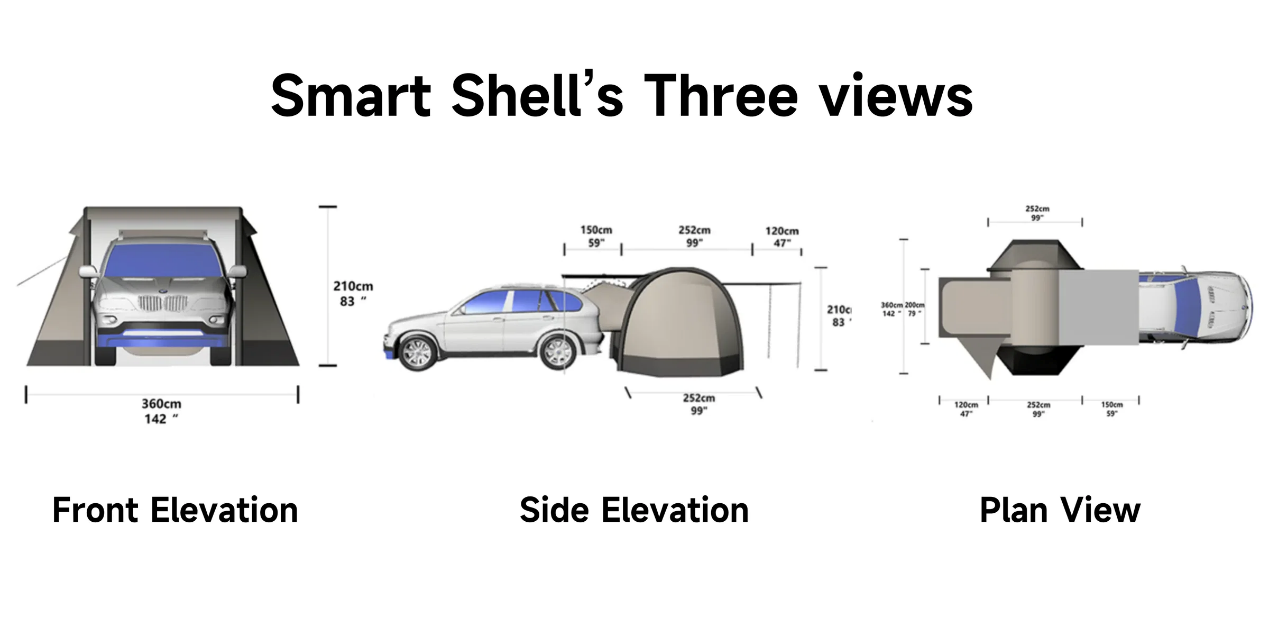
Smart Shell already supports three configuration rear tents, side tents, or standalone shelters showing how one vehicle-connected platform can adapt to different camping scenarios. It is also designed for both electric and gasoline vehicles, a useful foundation for broader integration as vehicle platforms become more diverse.
These features could make a vehicle-connected tent more convenient without changing its fundamental purpose. The shelter would still provide additional living space, but the interaction between the vehicle and tent would become more seamless.
Materials and Adaptive Design
Smart integration does not necessarily mean adding more electronics. Future development may also focus on materials that improve performance without increasing complexity.
Lighter fabrics, stronger structural components, improved weather resistance, and more efficient attachment systems could make car-connected shelters easier to transport and deploy. Modular components may also allow users to add or remove features according to different trip requirements.
THECATAL’s focus on outdoor equipment, and practical design provides a useful reference for this direction. Smart features will be most valuable when they complement core shelter functions rather than making products unnecessarily complicated.
Smart Shell currently uses silicon-coated ripstop 70D nylon and weighs 26 pounds (12kg), illustrating the importance of keeping material durability and overall weight in balance as additional smart functions are considered.
Improving Convenience for Different Users
Smart integration could benefit different types of campers in different ways. Families may value automated lighting and easier setup, while long-distance travelers may prioritize energy monitoring and environmental alerts.
Outdoor photographers, anglers, hikers, and remote workers could also benefit from better access to power and organized shelter space. As vehicle technology develops, camping systems may become increasingly customizable around individual travel patterns.
This does not mean every camper will need a highly automated setup. Simple products will continue to have value, particularly for users who prefer low-maintenance equipment. The opportunity lies in offering optional smart functions without removing the flexibility of conventional outdoor use.
Challenges of Connected Camping Equipment
Despite the potential advantages, smart camping integration also introduces challenges. Additional electronics can increase weight, power consumption, repair requirements, and product complexity.
Outdoor equipment must also withstand rain, dust, temperature changes, and repeated transportation. Components that function well in controlled environments may require more protection when exposed to real campsite conditions.
Compatibility is another issue. Different vehicles use different electrical architectures, software platforms, and connection systems. Manufacturers therefore need to consider interoperability and user simplicity when developing connected products.
These challenges suggest that future smart camping systems will need to balance innovation with reliability and practical maintenance.
The Future of Vehicle-Based Outdoor Travel
The integration of smart vehicles and camping shelters could gradually transform car camping into a more connected experience. Sensors, energy management, guided setup, environmental monitoring, and adaptive features may make vehicle-based accommodation easier to operate while improving the use of available resources.
For consumers and outdoor businesses, the most valuable developments are likely to be those that simplify real camping tasks rather than adding technology for its own sake. THECATAL represents an outdoor equipment approach where mobility and practical functionality remain central, providing a useful foundation for considering how future car camping systems can evolve alongside smarter vehicles.
