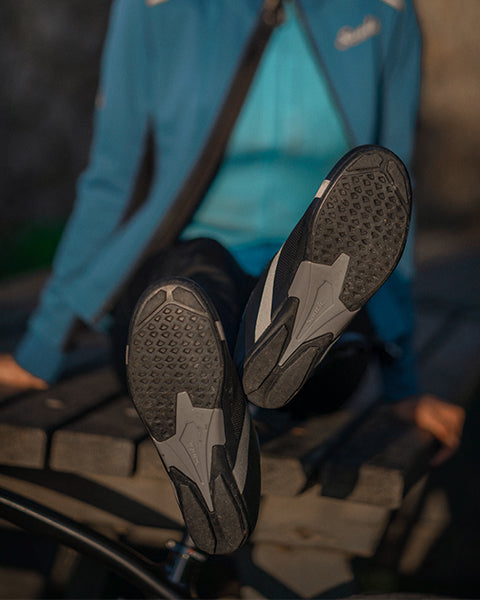
Grip on a flat pedal is not created by rubber softness alone. The sensation of a shoe “sticking” to a platform comes from several interacting features: the rubber compound, the shape and depth of the outsole texture, the size of the pedal contact area, the way the upper holds the foot over that area, and the stability of the heel.
A hardness figure can describe one material property, but it cannot by itself predict how securely a rider will feel connected to the bike. This is why two shoes with similar rubber ratings can behave differently once tread geometry, shank reinforcement, pedal pins, and foot movement enter the picture.
Grip level makes more sense when the outsole is treated as a mechanical interface; a Shore number describes only one material property within that interface. A rider therefore experiences the finished combination rather than an isolated laboratory value, and comparisons become meaningful only when material data is read beside tread and retention design.
Rubber Hardness Is a Starting Point, Not a Grip Score
Many mtb bike shoes use rubber because it can provide traction on a platform pedal while remaining practical for walking. A Shore A value provides a rubber-hardness reference, so it is useful for comparing compounds at a material level, but the number does not reveal the entire contact behavior of a finished sole.
A relatively compliant rubber may conform around pedal features, while a firmer construction can feel more supportive under load. The actual result also depends on thickness, pattern, reinforcement, and how much of the outsole is able to engage the pedal surface. That material reading differs from wide road shoes cycling, where a cleat rather than a broad rubber platform carries the pedal connection.
Cleated Road Systems Use a Different Interface
The contrast between material data and total fit becomes clearer outside the flat-pedal category. Unlike mtb bike shoes, wide road shoes cycling may use a stiff carbon platform and a roomy last rather than a soft rubber contact layer, because the rider is connected through a cleat instead of friction against a broad pedal.
That contrast shows why a single hardness figure cannot be transferred across shoe types. Flat-pedal grip has to be read in the context of a cleat-free interface, where outsole rubber and pedal contact are central to control rather than secondary to a mechanical cleat connection.
Outsole Geometry Changes How Rubber Is Used
Santic’s current flat-pedal specifications illustrate how mtb bike shoes can share a similar hardness range while using different outsole structures. Venus is listed with Rubber 65A and a Rubber + TPU Shank outsole. Firmament also uses Rubber 65A but combines it with an RB rubber outsole, while Caribbean 2.0 uses Rubber 65A with a rubber outsole and Caribbean 3.0 is listed at Shore 65A.
Apollo 3.0 adds another layer of complexity: its outsole is rubber with an embedded carbon-fiber plate and carries Shore values of 65A/85–90D. Those details make clear that compound hardness sits beside structural reinforcement rather than replacing it. A comparison with wide road shoes cycling must therefore separate rubber-compound data from cleat-based sole stiffness.
Tread Geometry Converts Material into Contact
In mtb bike shoes, surface design determines how the compound meets the pedal. Apollo 2.0 uses a raised-sheet outsole form with a diamond texture to increase contact, and its cleat-free construction leaves the outsole available for direct interaction with the pedal surface. Firmament takes a different route with a VIBRAM rubber + TPU hybrid outsole.
Even wide road shoes cycling demonstrate the opposite end of the design problem: Santic’s Cruise uses a stiffness-12 carbon-fiber outsole, a wide last, and a wide toe box, so its performance depends on cleat engagement and rigid force transfer rather than on rubber conforming around a platform pedal. Grip level is therefore a product of architecture, not merely compound selection.
Foot Lockdown Determines Whether Grip Can Be Used
A grippy outsole cannot stabilize the rider if the foot is sliding inside the shoe. For that reason, flat-pedal cycling shoes can combine pedal contact with retention systems that control movement above the sole.
Firmament uses a Santic X ETIE dial for fine compression adjustment, a reverse-scale inner lining intended to improve foot grip, TPU reinforcement, a RaceLock heel cage, and CoolStream ventilation. Apollo 2.0 uses an Atop micro-adjustable dial, a Velcro forefoot strap, and a V-heel cup. These structures address a different layer of “grip”: not rubber against pedal, but foot against shoe.
Fit volume also affects how consistently that contact can be maintained. A shoe that is too loose can allow lateral or fore-aft movement, while excessive compression can create discomfort before outsole traction becomes the limiting factor. That is why the fit logic seen in wide road shoes cycling remains relevant even though the pedal systems differ.
Cruise, for example, is listed with a wide last and wide toe box, showing that forefoot volume is treated as a design variable rather than an afterthought. In flat-pedal riding, the corresponding goal is to place the foot securely over the rubber platform so the outsole texture and compound can work as intended.
Rubber compound influences flat-pedal behavior, but grip level emerges from a larger system. Shore values provide useful material information; tread form, contact area, shank or plate reinforcement, upper closure, heel containment, and fit determine how that material behaves under a rider.
Santic’s flat-pedal range shows several ways to build around similar rubber hardness figures without producing identical outsole structures. A 65A label alone cannot answer the grip question. The more meaningful comparison examines how rubber, geometry, structural support, and foot retention work together at the pedal interface.
