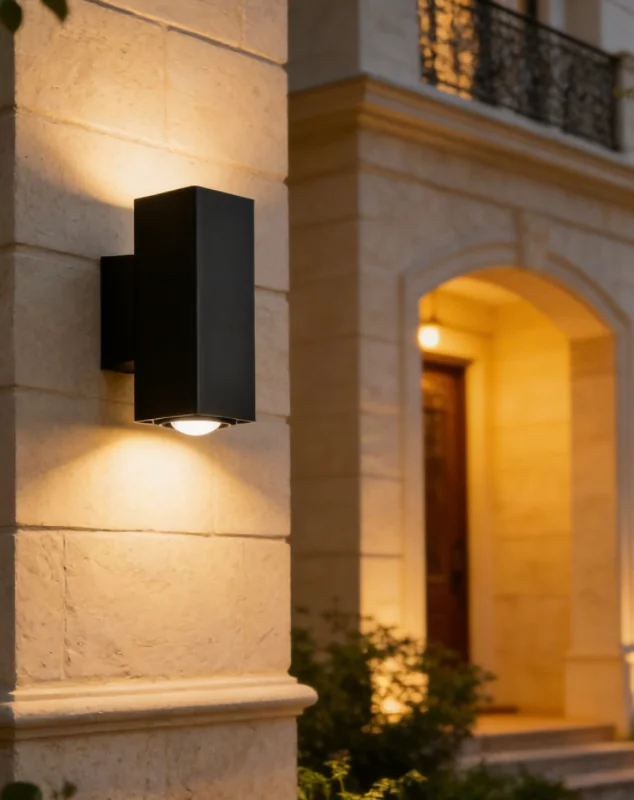
Selecting appropriate motion detection technology represents a crucial specification decision when planning commercial exterior illumination. Motion-activated fixtures improve night security and reduce energy waste, making them essential across corporate campuses, residential complexes, and public infrastructure projects.
When evaluating an outdoor motion sensor light for commercial applications, project engineers and B2B buyers must choose between integrated sensor modules and external control setups. Each configuration offers distinct advantages regarding installation labor, aesthetic integration, and long-term operational flexibility.
Manufacturers such as Keyida engineer diverse sensing solutions built to satisfy rigorous commercial performance standards. Understanding the core structural and operational trade-offs between integrated and external sensing architectures allows procurement managers to select optimal fixtures for specific site conditions.
Integrated Sensing Systems in Custom Outdoor Lighting
Integrated sensor fixtures incorporate detection components directly within the luminaire housing, creating a self-contained, weather-sealed unit. Microwave radar or Passive Infrared sensors sit behind durable diffusers, preserving clean architectural lines while shielding sensitive internal components from harsh environmental exposure.
This streamlined construction simplifies installation significantly, as installation crews mount a single fixture without wiring standalone sensor boxes. For custom outdoor lighting projects requiring uniform visual aesthetics across pathways and building facades, built-in detection delivers a clean, highly unobtrusive appearance.
However, integrated modules present specific maintenance considerations over long operational cycles. If an internal sensor requires attention, repairing or replacing the component involves servicing the luminaire housing itself, which can temporarily disrupt illumination along targeted exterior pathways or building perimeters.
External Outdoor Motion Sensor Light Configurations for Flexible Zone Control
External motion detection setups utilize separate sensor units mounted independently from the primary light fixtures. These standalone devices connect to one or multiple luminaires via external wiring, transmitting activation signals when movement crosses designated detection zones.
This decoupled arrangement allows facility managers to position detection units at strategic vantage points, such as high-traffic gates or blind corners. Consequently, a single external sensor can trigger multiple luminaires simultaneously, establishing broad zone illumination before visitors reach main building entrances.
The primary trade-off of external control systems involves higher installation complexity and exposed mounting hardware. Running additional electrical conduit increases labor costs during initial construction, while exposed sensor housings require ongoing maintenance inspection to prevent physical or environmental damage.
Technical Considerations and Sensor Engineering for Commercial Sites
Choosing between integrated and external detection depends heavily on the underlying sensing technology deployed. Radar sensors detect movement through high-frequency electromagnetic waves, penetrating diffusers easily, whereas Passive Infrared sensors rely on direct thermal line-of-sight across target areas.
An integrated outdoor motion sensor light featuring internal radar technology operates effectively behind UV-stabilized PC or acrylic diffusers without compromising detection sensitivity. This sealed structure protects internal electronics against moisture ingress, securing reliable performance across varying seasonal weather conditions.
Conversely, external PIR units excel in open exterior environments where long-range, directional thermal detection is needed. However, direct exposure to intense solar radiation, driving rain, and cold air currents can occasionally trigger false activations if external housings lack proper IP-rated waterproofing.
Scenario-Based Selection for Commercial Facilities and Real Estate
Matching sensor architecture to specific site demands ensures long-term operational efficiency for commercial facilities. Compact wall washers, garden bollards, and perimeter step lights benefit immensely from integrated sensor designs that maintain sleek, minimalist product silhouettes.
Keyida supports wholesale distributors and project contractors by offering modular OEM and ODM manufacturing capabilities. Custom housing finishes, specialized beam angles, and tailored sensor sensitivity settings allow procurement teams to adapt standard models to unique architectural project requirements.
For expansive industrial yards, logistics centers, or multi-level parking structures, external sensor configurations frequently prove more cost-effective. A single high-mounted external motion detector can trigger a chain of floodlights, maximizing coverage while optimizing overall equipment procurement budgets.
In complex projects requiring specialized custom outdoor lighting, combining both sensing technologies across different zones of a single property often yields the best balance between subtle architectural styling and comprehensive security coverage.
B2B Support, Customization Options, and Compliance Standards
Facilitating smooth global procurement, commercial production caters to flexible order volumes across international distribution networks. Practical Minimum Order Quantity terms—200 units for standard product runs and 800 units for custom color options—allow buyers to align inventory strategy with market demand.
Complete technical documentation accompanies all commercial orders, including detailed 2D CAD layouts, high-resolution product imagery, and comprehensive installation guides. Full certification compliance with CE, RoHS, and SAA standards ensures seamless customs clearance and code compliance across key international markets.
Optimizing Commercial Projects with Dependable Sensing Solutions
Deciding between integrated and external detection relies on balancing visual aesthetics, maintenance protocols, and coverage requirements. Integrated luminaires provide streamlined installation and sleek styling, whereas external units offer flexible positioning and multi-fixture control capabilities across expansive property layouts.
Operating a 7,000 m² manufacturing plant and an 1,100 m² showroom, the enterprise develops proprietary mold options quarterly. Utilizing heavy-duty aluminum bodies with sanded, powder-coated finishes, every fixture delivers exceptional weather resistance and lasting structural integrity.
Supported by a standard 3-year warranty and a real-world service life reaching 5 to 6 years, these sensing solutions deliver dependable performance. Partnering with Keyida provides commercial clients with certified, reliable luminaires engineered to satisfy demanding exterior illumination requirements.
