Modern additive manufacturing requires reliable machinery that operates around the clock. Industrial sectors face increasing demands for speed, material consistency, and structural density. Identifying the best industrial metal 3D printer involves examining technical specifications and real-world performance.
Continuous production regimes require minimal intervention and high operational repeatability. Equipment must handle fine metal powders while maintaining stable inert gas environments. Advanced systems integrate multi-layer safety mechanisms to prevent oxidation and ensure operator safety.
Technical Standards from Leading Metal 3D Printer Manufacturers
Global industrial buyers evaluate hardware based on throughput and long-term operating costs. Leading metal 3D printer manufacturers focus on laser efficiency, thermal management, and gas filtration. These engineering factors dictate how consistently a system performs in demanding environments.
Selective Laser Melting technology relies on precise beam control to fuse metallic powders. High-precision optics ensure that mechanical properties remain uniform across the entire build envelope. This reliability is essential for high-volume laboratories and automated production lines.
Automated powder recoating mechanisms are equally vital for maintaining layer uniformity. Precise mechanical drives ensure consistent powder distribution across the build plate. This consistency reduces internal porosity and eliminates structural flaws in critical medical and industrial parts.
Hardware stability directly impacts part quality and surface finish during prolonged operation. Manufacturers should design rugged machine chassis that reduce ambient vibrations during scanning. Advanced multi-laser configurations further boost output without compromising geometric accuracy.
Evaluating the Best Industrial Metal 3D Printer Capabilities
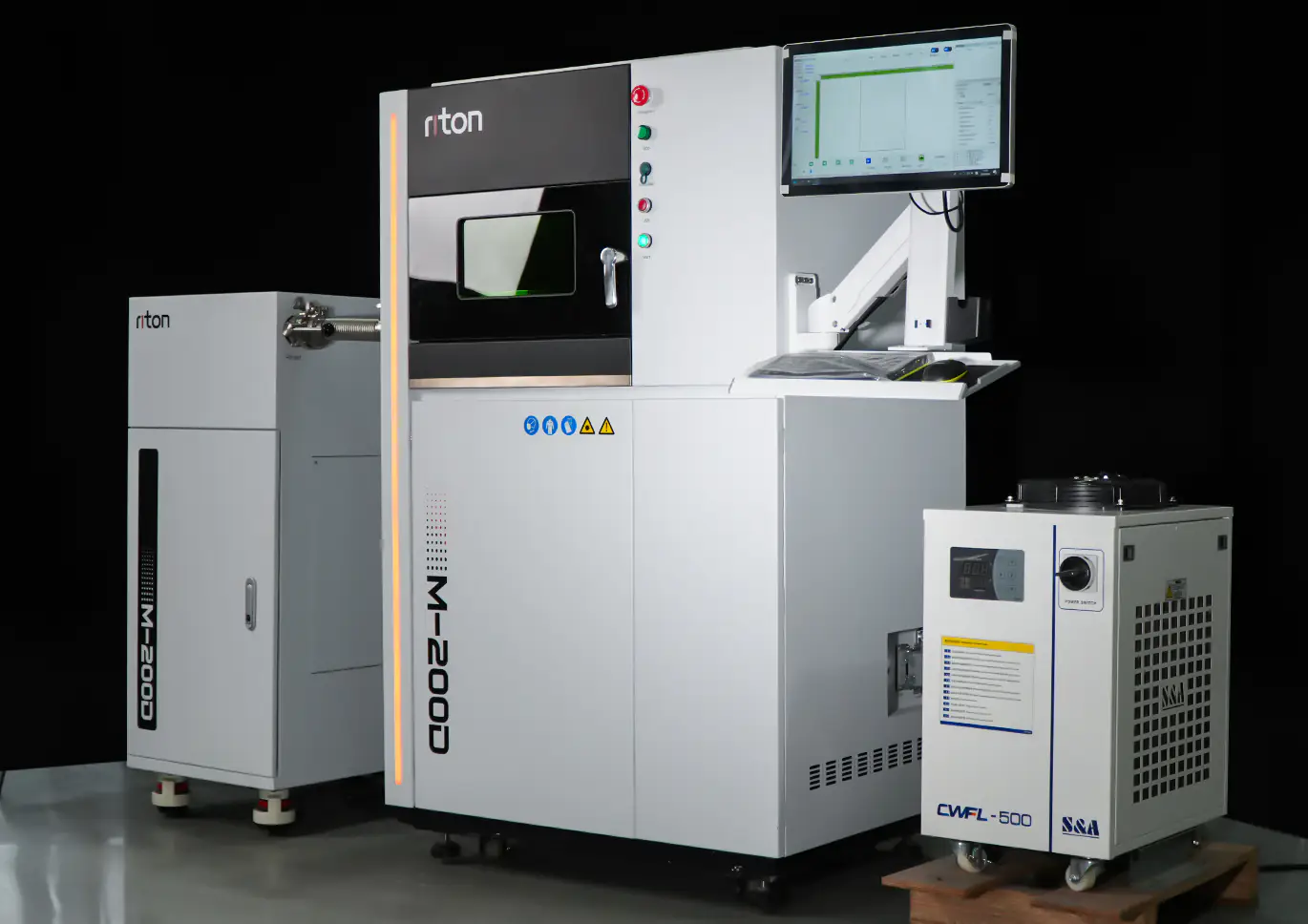
High‑volume production calls for hardware equipped with enhanced laser performance and well‑optimized powder delivery systems. The best industrial metal 3D printer must deliver consistent thermal stability across consecutive production cycles. Equipment engineered by Riton illustrates how hardware design satisfies these strict operational parameters.
In particular, the M-200D model demonstrates how double fiber lasers drastically accelerate output. Operating at a laser wavelength of 1.064μm, each laser delivers up to 500W of focused energy. This setup achieves melting speeds reaching 14000mm/s.
Process efficiency increases substantially when dual lasers operate simultaneously without thermal interference. Advanced optical calibration aligns laser paths across overlapping scan fields. This synchronized scanning minimizes thermal gradients across large component surfaces.
For high-volume prosthetic labs, this speed yields up to 430 crowns or 35 partial frameworks in 5.5 hours. A melting area of 220 x 150 x 140mm accommodates dense component layouts while keeping the physical footprint remarkably compact.
Unique Engineering and Performance Strengths
Continuous operation generates significant particulate byproduct that can degrade laser transmission. To solve this, Riton integrates a permanent filter with an automated back-blowing function into the M-200D. This design maintains chamber cleanliness and extends filter lifespan.
Back-blowing technology continuously cleans internal filters during operation without interrupting the build cycle. Gas circulation systems maintain stable chamber pressure throughout extended runs. This automated filtration guarantees consistent laser intensity from start to finish.
Controlling layer thickness between 20 and 60μm allows operators to fine-tune density and surface smoothness. Intelligent gas control systems minimize protective Argon or Nitrogen consumption. These energy-efficient features significantly reduce the overall cost per printed part.
In-house developed smart control software regulates laser parameters and monitors temperature in real time. For experienced technicians, integrated telemetry prevents print failures before they occur. This level of automation guarantees batch-to-batch repeatability for critical metal alloys.
Brand Value and Technical Services Ecosystem
A complete additive solution extends beyond hardware parameters into software and ongoing service support. As trusted metal 3D printer manufacturers, Riton provides end-to-end digital integration tailored to experienced enterprise clients. Pre-sales technical consultation ensures seamless workflow adoption.
Post-sales technical support includes routine maintenance, software updates, and rapid component delivery. Established global distributor coordination networks provide localized servicing across international markets. This localized support minimizes unexpected downtime for high-volume commercial production environments.
Enterprise clients benefit from customized training protocols designed for skilled lab technicians. Proper system calibration ensures that specialized materials, including cobalt-chromium and titanium alloys, maintain high mechanical integrity. Comprehensive technical assistance safeguards long-term capital investments.
Integrated Industrial‑Grade Solutions
Performance‑validated multi‑laser platform capabilities demonstrate the commercial advantages for high‑volume dental production. Laboratories operating the M‑200D benefit from notable improvements in throughput and reduced turnaround times, supported by its rated capacity of 430 crowns or 35 partial frameworks within a 5.5‑hour build cycle. Digital workflows replace labor‑intensive casting steps with precise, reproducible additive execution.
Transitioning to digital manufacturing requires comprehensive software alignment across the production chain. Native control software accepts standard CAD files and streamlines slice preparation. Direct software integration accelerates processing times and reduces human error during pre‑processing, matching the end‑to‑end digital workflow requirements of serial dental component production.
To minimize unplanned production downtime, Riton implements localized servicing models and efficient spare‑parts logistics. Regional distributor networks provide access to trained technical engineers, backed by a global installed‑base footprint. This service‑oriented infrastructure builds reliable support for international enterprise buyers.
The shift toward fully digital additive manufacturing relies on proven machine‑level stability. Selecting purpose‑built industrial metal 3D printers optimizes material utilization for target dental materials including cobalt‑chromium and titanium. Lower powder waste contributes to healthier operational margins for high‑volume lab facilities.
Future Outlook for Industrial Additive Manufacturing
As additive standards evolve, top metal 3D printer manufacturers continue refining laser control and automation. Strategic investments in research and development drive continuous hardware upgrades. Enterprise adopters benefit from increased automation, improved material density, and faster execution.
Selecting equipment from established pioneers ensures long-term operational success and software compatibility. Advanced multi-laser hardware combined with global technical support empowers manufacturers to meet rising production targets. Efficient additive engineering continues to redefine modern industrial production worldwide.
