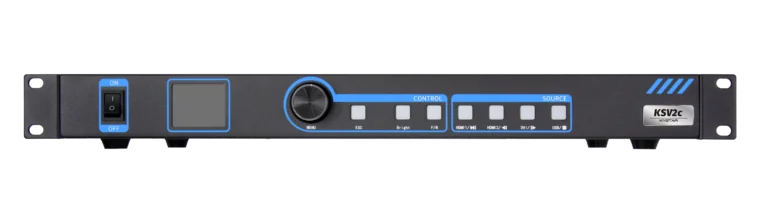
When building an LED display system, many buyers assume that any digital video LED controller can be connected to any LED screen. However, this is not always the case. Although controllers are designed to manage video signals and LED displays, compatibility depends on several technical factors, including screen specifications, control protocols, resolution requirements, and system configuration.
Choosing the right controller is essential for achieving stable image quality and reliable operation. A mismatch between the controller and LED screen may lead to problems such as incorrect display mapping, poor image performance, or failure to show content properly. Kystar provides professional LED control solutions, including integrated video controllers designed for different LED display applications.
Why a Digital Video LED Controller Cannot Work with Every LED Screen?
A digital video LED controller acts as the connection point between a video source and an LED display. It processes input signals, manages image output, and sends data to LED modules through the display control system. However, LED screens are not standardized in the same way as traditional monitors or televisions.
Different LED screens use different receiving cards, driver chips, module structures, and cabinet designs. The controller must communicate correctly with these internal components to display images accurately.
For example, a controller designed for a small indoor LED wall may not provide enough processing capacity for a large outdoor display with millions of pixels. buchong1Similarly, a high-performance controller may not be the best choice if the LED screen has specific hardware limitations.
Compatibility Between Controllers and LED Receiving Systems
One of the most important compatibility factors is the relationship between the digital video LED controller and the receiving cards installed inside LED cabinets.
The receiving card controls how image data is delivered to LED modules, while the controller manages signal processing and distribution. These two parts must support compatible communication methods and configuration settings.
If the controller and receiving system are not properly matched, the LED screen may experience issues such as abnormal colors, incorrect scanning, missing areas, or unstable images. Therefore, checking compatibility before installation is a necessary step for any LED project.
Kystar’s integrated LED video controllers combine video processing and sending card functions, helping simplify system configuration for various LED display projects. The KLSxC series supports different project sizes with different loading capacities and output configurations.
Screen Resolution and Loading Capacity Matter
Another key factor is the processing capacity of the controller. Every digital video LED controller has a maximum pixel loading capability, which determines how many pixels it can manage.
A small LED screen may only require a basic controller, while a large fine-pitch LED wall in a conference center, stage, or command center requires stronger processing performance.
If the screen resolution exceeds the controller’s capacity, the system may not display the entire image correctly. Content may be cropped, reduced in quality, or divided incorrectly across the display.
Professional controllers are designed with different output capacities to support different screen sizes. For example, Kystar’s KLS series includes models with different numbers of network ports and loading capabilities, allowing users to select a suitable solution based on project requirements.
Different LED Applications Require Different Controller Features
Not all LED screens are used in the same environment. A controller suitable for a simple advertising display may not meet the requirements of a concert stage, XR production studio, or creative LED installation.
Live events often require fast switching between multiple video sources, flexible screen layouts, and stable operation during long performances. XR stages require accurate image processing and synchronization because LED screens become part of the camera environment.
Commercial installations may focus more on long-term reliability, easy management, and consistent image quality. In these cases, choosing a controller with the right features is more important than simply selecting the most powerful model.
Kystar designs video controllers for applications including stage backgrounds, exhibition halls, conference rooms, shopping malls, sports venues, and creative LED displays. The KLSxC series supports functions such as multi-layer layouts, multiple screen management, and flexible display configurations.
What Should Be Checked Before Selecting a Controller?
Before connecting a digital video LED controller to an LED screen, project designers should confirm several technical requirements. The controller must match the LED screen’s resolution, receiving system, signal format, and operational needs.
Input compatibility is also important because different projects may use different video sources, including computers, cameras, playback systems, or professional production equipment. A suitable controller should support the required input signals while providing enough output capacity for the LED wall.
The physical installation environment should also be considered. A rental LED screen used for touring events may require flexible setup and quick configuration, while a fixed installation may prioritize stability and long-term operation.
By evaluating these factors before installation, users can avoid compatibility problems and create a more reliable LED display system.
Benefits of Using a Properly Matched LED Controller
A correctly matched digital video LED controller improves both performance and efficiency. It allows the LED screen to display content with accurate colors, smooth motion, and consistent brightness.
It also simplifies maintenance because technicians can diagnose and adjust the system more easily when all components are properly configured together.
For large and complex LED projects, using a suitable controller can improve workflow efficiency by reducing unnecessary equipment and making system management easier. Integrated controllers that combine processing and sending functions can also reduce installation complexity.
Kystar’s two-in-one processor solutions integrate video processing and LED sending functions into one device, providing a streamlined approach for professional LED display control.
Conclusion
A digital video LED controller cannot automatically work with every LED screen. Compatibility depends on factors such as receiving card communication, pixel loading capacity, screen resolution, input requirements, and application environment.
Selecting the correct controller requires understanding the technical requirements of the LED display rather than choosing equipment based only on appearance or price.
For projects ranging from commercial LED walls to stage productions and advanced visual installations, a properly matched control system ensures better image quality, easier operation, and long-term reliability. With professional LED processing technologies, Kystar helps customers build efficient and stable display solutions for different application scenarios.
