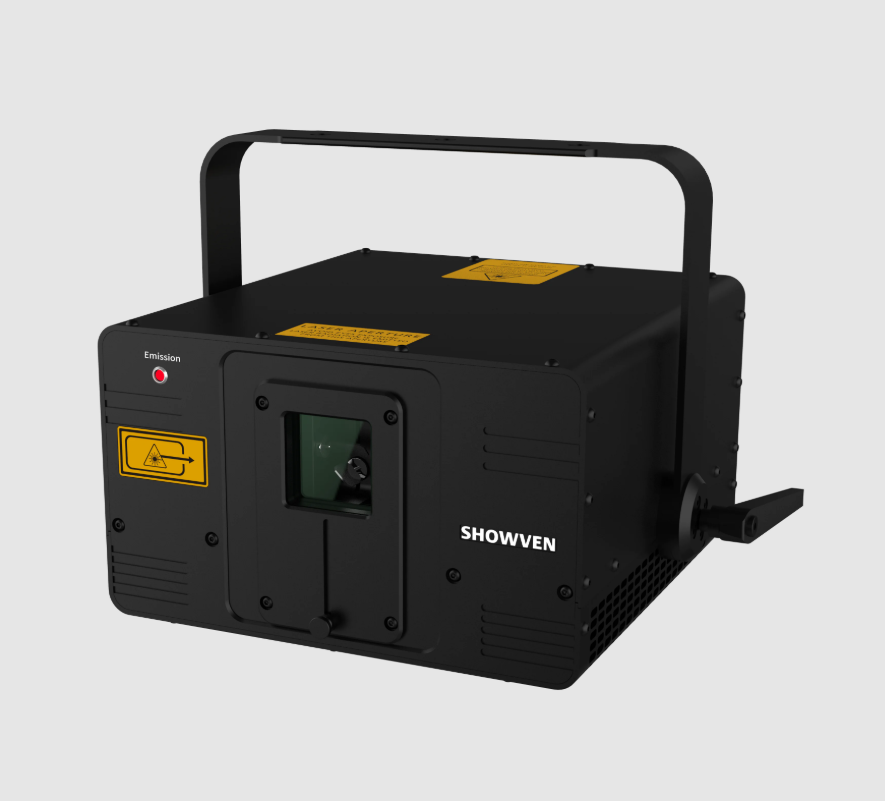
When organizing an event that demands a visually spectacular atmosphere, few elements can captivate an audience like a professional laser system. However, when selecting equipment, many event producers, rental companies, and lighting designers fall into a common trap: believing “brighter is always better.” The true challenge lies in finding the optimal balance between visual impact, compliance, and, most importantly, audience safety. This comprehensive guide will help you understand the science behind laser brightness, how to calculate the power (measured in milliwatts, or mW) necessary for your specific venue, and the critical factors that separate a stunning visual display from a potentially hazardous setup. The question isn’t just “how bright,” but “how safely and effectively bright.” For those aiming to deliver a high-energy environment, the DJ laser light is the core component of any dynamic setup. Unlike conventional LED effects, lasers use focused beams to create geometric shapes, tunnels, and aerial effects that cut through the darkness. Understanding the correct power rating is fundamental to achieving your desired effect without compromising safety standards.
The Science of Brightness: Why mW Matters More Than Lumens
In the world of professional lasers, brightness is fundamentally not measured in lumens, which is a unit for total visible light, but in milliwatts (mW) or watts (W). This measurement denotes the laser’s optical output power, which is the single most critical factor determining both the light’s visible intensity and its potential to cause eye injury. Consequently, it is essential to recognize that a higher mW rating implies greater power and, therefore, greater safety responsibility. The required mW level is determined by several interconnected environmental and technical factors. Primarily, the venue size and beam throw is the decisive considerations, as they dictate how far the laser beams must travel to be visible; a large concert hall will require significantly more power than a small, intimate venue. Additionally, the level of ambient light plays a crucial role; even a powerful laser can be washed out by competing stage lighting or large LED screens, necessitating sufficient power to “cut through” this background light. Furthermore, while haze or fog density is crucial for creating the “canvas” on which the beams are seen, a higher power laser is nevertheless needed to penetrate thicker atmospheric effects over long distances and maintain beam visibility.
Matching Power to Venue: Brightness Requirements by Setting
Choosing the right laser power for different venues generally follows industry patterns, but these ranges should be viewed as guidance rather than fixed standards, as regulations, beam quality, and safety distances vary widely. In smaller venues such as bars, systems around 300 mW to 1 W usually deliver sufficient short-throw effects when beams remain above audience height and comply with local rules. As environments grow more complex—like medium-sized clubs where ambient lighting competes with laser visibility—operators often choose between 2 W and 8 W, a range commonly associated with professional nightclub lasers, to maintain clarity and achieve immersive atmospheric effects.
Large nightclubs, concert halls, and festival stages often require more than 8 W, sometimes exceeding 20 W, to support long-throw projection and high-impact visuals. However, such high-power Class 3B and Class 4 systems demand strict safety management, proper beam termination, and—where required—formal licensing. Ultimately, power alone does not determine suitability; factors such as beam divergence, scanning parameters, safe viewing distances, atmospheric density, and restrictions on audience scanning are equally crucial to achieving a visually impressive yet compliant laser installation.
Safety and Stability: Choosing Professional-Grade Laser Solutions
Regardless of the application—from a DJ set to a major ceremony—laser safety remains the most critical factor. High-power systems fall under Class 3B or Class 4, where direct or reflected exposure can cause permanent eye injury. Therefore, professional setups must include essential safety measures and follow strict protocols, such as terminating beams on non-reflective surfaces above audience level. Key safety components include physical keys, interlocks, and remote emergency stops. Ultimately, the ideal laser brightness is one that delivers the intended visual impact while maintaining reliable and integrated safety protection.
For B2B projects, the engineering quality of high-power lasers is equally essential, making it important to choose suppliers that prioritize safety and system stability. Showven Laser specializes in high-end stage technology and offers the Maiman series, designed for demanding environments such as festivals and large events. Models like the Maiman10 feature an IP65-rated dual-layer housing, digital RGB + TEC drive, and advanced TEC cooling for strong thermal stability. This safety-first, durable structure ensures consistent performance across both outdoor productions and intensive club applications.
In conclusion, the optimal brightness for a DJ laser light is not a fixed number but a calculation derived from your venue size, ambient light, desired effect, and, critically, your unwavering commitment to safety compliance. For all professional applications, always prioritize quality, integrated safety features, and robust construction over simply seeking the highest mW rating. By selecting specialized, high-performance equipment like that offered by Showven Laser, you ensure your light show is not only spectacular but also professionally safe and reliably executed for years to come.
