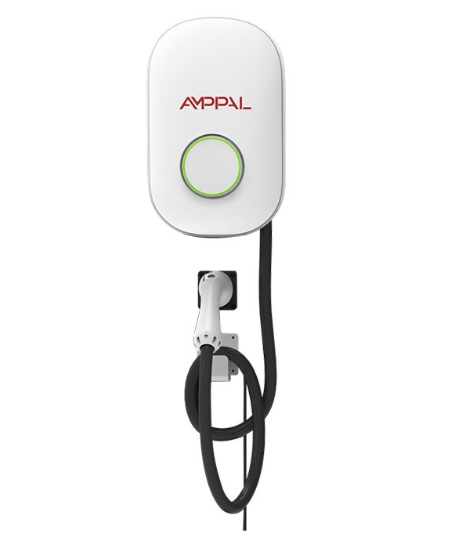
The transition to electric vehicle (EV) fleets and the rollout of public charging infrastructure represent a paradigm shift in energy consumption. For businesses, understanding the underlying technology—specifically how an AC charger EV operates—is crucial for making informed investment decisions regarding efficient, reliable, and scalable charging solutions.
Unlike Direct Current (DC) fast chargers, which perform the conversion outside the vehicle, Alternating Current (AC) charging leverages existing grid infrastructure and relies on sophisticated components inside the car. This distinction impacts installation costs, charge speed, and utility demands, making AC chargers the foundational element for destination, workplace, and overnight fleet charging.
This guide provides an in-depth, technical explanation of the AC charging process, highlighting why robust hardware, like the solutions provided by AMPPAL, is the backbone of successful electrification strategies.
The Essential Difference: AC vs. DC Charging
To understand how AC charging works, one must first grasp the core electrical requirement of the EV battery. All EV batteries, similar to the battery in your mobile phone, store and utilize energy in the form of Direct Current (DC).
However, the global electrical grid, which delivers power to homes and businesses, uses Alternating Current (AC) because it is more efficient for long-distance transmission. Therefore, the essential challenge in EV charging is conversion.
- DC Charging (Level 3/Fast Charging): The conversion from AC grid power to DC power occurs within the charging station itself (the EVSE). This external converter is large, powerful, and expensive, enabling extremely high power flow directly to the vehicle’s battery, bypassing the car’s internal conversion components almost entirely. This results in rapid charging, typically used for quick stops on highways.
- AC Charging (Level 1 & Level 2): The conversion from AC to DC is handled by a device inside the vehicle known as the onboard charger (OBC). The physical AC charging station (often called Electric Vehicle Supply Equipment, or EVSE) acts primarily as a smart conduit, communicating the available power capacity, managing safety protocols, and ensuring a secure connection between the grid and the vehicle.
For most commercial installations where vehicles dwell for hours—such as employee parking lots, multi-family residences, or delivery depots—AC charging provides the perfect balance of cost-efficiency, hardware longevity, and sufficient charging speed.
The Core Mechanism of Level 2 EV Chargers
The vast majority of commercial and public charging facilities utilize level 2 EV chargers, which draw power from a 208V to 240V circuit, significantly faster than a standard 120V Level 1 residential outlet. This higher voltage is key to accelerating the charging cycle and enabling high power outputs ranging from 3.7kW up to 22kW or 44kW for commercial three-phase systems.
The charging mechanism involves a sophisticated five-step electronic handshake orchestrated by the EVSE, regardless of whether it’s a standard 7kW unit or a higher-capacity solution.
1.Plug-In and Initial Check: The user connects the charging connector (e.g., Type 2 or J1772) to the vehicle. The EVSE, which is often managed by a central system via OCPP, detects the connection and initiates a self-test and safety check, including grounding verification.
2.Proximity Pilot Signal: The EVSE sends a low-power “Proximity Pilot” signal (a simple resistor measurement) through the cable to confirm the plug is correctly seated and the vehicle is ready to receive power. This safety mechanism prevents power delivery until a secure physical connection is established.
3.Control Pilot Communication: This is where the “intelligence” of the charging session begins. The EVSE sends a Control Pilot signal (a varying pulse-width modulation signal) that informs the vehicle’s onboard charger of the maximum current the charging station can safely provide (the Available Current).
4.Vehicle Negotiation: The EV’s onboard charger reads the available current limit and, based on its current battery state of charge (SoC) and temperature, calculates the maximum current it can safely accept (the Requested Current). The OBC signals this requested rate back to the EVSE. Crucially, the final charging rate is always the lower of the two: what the station can supply or what the vehicle requests.
5.Power Delivery and Conversion: Once the safe charging current is agreed upon, the EVSE closes the internal relays, allowing AC power to flow to the vehicle. The AC is immediately routed to the onboard charger, which converts it to DC, regulates the voltage, and feeds the appropriate current to the battery pack cells via the Battery Management System (BMS).
This intricate, continuous communication ensures power is delivered safely and efficiently, maximizing the lifespan of the battery while minimizing strain on the infrastructure.
Integrating AMPPAL into Commercial Infrastructure
For commercial operators, the performance and reliability of the AC charger EV hardware are paramount. The AMPPAL line of charging stations is engineered specifically to meet the high demands of B2B applications, ensuring compliance, connectivity, and durability.
Consider the specifications of the 7kW Wall-Mounted AC Charging Station (Model AF-AC-07-B-A-O-2/4-SC), which exemplifies the robust design philosophy of AMPPAL:
| Specification | Detail | Importance for B2B |
| Rated Power | 7KW (Single-Phase) | Ideal for standardized Level 2 workplace or fleet depot overnight charging. |
| Connectivity | OCPP 1.6J | Essential protocol for integration with third-party billing, management, and smart load-balancing platforms. |
| Ingress Protection | IP54 | Durable rating ensuring protection against dust and splashing water for outdoor and semi-outdoor environments. |
| Output Current | 32 A | Maximum delivery current at 220V, providing peak efficiency for the 7kW capacity. |
Whether utilizing the 7kW wall-mounted unit for small-scale deployment or leveraging the higher-capacity 22kW and 44kW three-phase options, the AMPPAL architecture ensures seamless integration with fleet management software and existing power distribution networks. This focus on OCPP 1.6J means your charging network is future-proof and ready for smart charging capabilities like scheduled charging and demand-side management.
Strategic Benefits of Robust AC Charging Infrastructure
Choosing reliable level 2 EV chargers is a strategic decision that goes beyond simply providing power. For fleet operators, reliable AC charging minimizes vehicle downtime and extends battery health by utilizing slower, consistent charging cycles. For commercial real estate developers, integrated, durable AC charger EV units increase property value and attract tenants focused on sustainability.
By partnering with a manufacturer like AMPPAL, which specializes in high-quality power components and full system integration, businesses can deploy charging infrastructure that is built to last, fully certified (e.g., CE, UL, TUV), and optimized for continuous operation in demanding commercial settings.
